
TL;DR
- A 6-person Midwest agency added $42K MRR in 90 days by saying yes to email work they used to refer out. That’s the whole pitch in one number.
- Most articles tell you white label email marketing is a piece of software you resell. It isn’t. It’s a service relationship where another team executes under your brand.
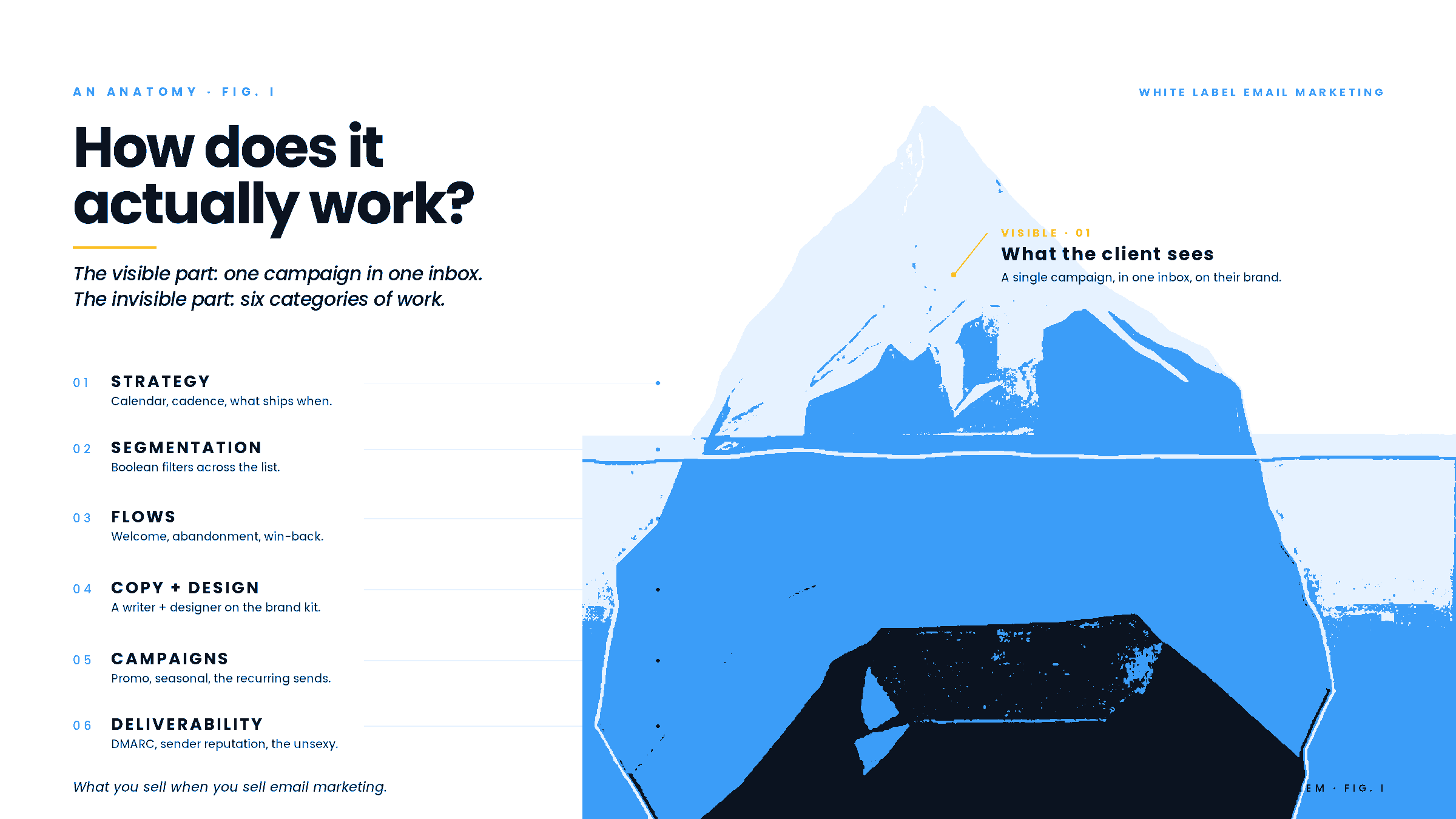
- The visible part is one branded campaign hitting one inbox. The invisible part is six categories of work: strategy, segmentation, flows, copy plus design, campaigns, and deliverability.
- Your agency keeps the client, the strategy positioning, the reporting cadence, and the credit. The partner keeps their name off everything.
The first time an agency owner told me he’d been turning away email work for three years, I asked him what it was costing him.
He didn’t know. So we counted.
Twenty-two active clients. Eight had asked about email at some point. Three had hired a freelancer he’d referred. The freelancer’s monthly take across those three was $9,000. None of it went through his books. None of it counted as agency revenue. None of it locked the client in further.
That same agency added $42K MRR in 90 days after switching to a white-label model. Same clients. Same offer. Different back end.
So when somebody asks me how white-label email marketing works, I don’t start with the definition. I start with what’s been costing them money to avoid.
The dominant SERP claim is wrong
Search “how does white label email marketing work” and you’ll get a hundred articles telling you it’s a software model. Buy a platform, slap your logo on it, resell it to clients. Done.
That’s not it. That’s a reseller program for an email service provider, which is a different product entirely.
Real white-label email marketing is a service relationship, not a tool relationship. You’re not licensing software. You’re partnering with a team that does the campaigns, the flows, the segmentation, and the reporting on your client’s account, under your agency’s name, without ever appearing in the relationship.
The distinction matters because the buyer’s experience is completely different. A reseller program means you’re still the one writing the emails. A white-label service means the emails get written, designed, scheduled, and reported on. You see the dashboard. The client sees your face.
That’s the whole shift. Software-as-a-product becomes work-done-for-you.
One inbox, six invisible categories underneath
Picture an iceberg. The waterline is the client’s inbox.
Above the waterline: a single campaign lands. The subject line is on-brand. The hero image matches the client’s last landing page. The send time is 9:14 a.m. Tuesday. The client opens it from her phone and forwards it to her co-founder with a “this looks great.”
Below the waterline, six things have already happened, and none of them carry the white-label team’s name.
Strategy. Someone mapped the calendar. They decided this campaign goes before the welcome-flow refresh and after the post-purchase upsell. They flagged that the brand is going into Q4 with three product launches stacked, so the cadence needs to dial up by week 4. The agency owner approved the strategy. The execution happened elsewhere.
Segmentation. The list got cut. Not “all subscribers.” Engaged-90-days minus VIPs minus high-recent-purchase minus churned-six-months. That’s four boolean filters, applied in Klaviyo or Omnisend or wherever the client’s data lives. It took 25 minutes and didn’t get any credit because the recipient never sees a segment ID.
Flows. The automated stuff. Welcome series, abandonment, browse, post-purchase, win-back, replenishment. Most agencies under-build these and then wonder why campaigns are doing all the lifting. The white-label team rebuilt the welcome series last month from 7 emails to 3 with a concentrated offer; 90-day LTV moved. The client’s dashboard shows the lift. The agency owner gets the credit.
Copy and design. A copywriter wrote. A designer designed. Both of them used the client’s brand kit (uploaded once, referenced forever) and the agency’s voice notes. The output landed in the agency’s review folder under the agency’s project name. The agency owner approved, made one note, and shipped.
Campaigns. The recurring sends. Promo calendar, seasonal pushes, content drops, abandoned-cart broadcasts. These are the things that show up in the client’s revenue report under “email channel.” The white-label team built and scheduled them. The agency owner forwards the result.
Deliverability and reporting. The unsexy stuff that decides whether anything works. DMARC, SPF, DKIM, sender reputation, list hygiene, soft-bounce monitoring, the Postmaster Tools account most agencies have never opened. Plus the monthly report. Plus the loss prevention when a domain gets flagged.
That’s the iceberg. One inbox above. Six categories of work below. The whole reason this model exists is so the work below the waterline gets done by people who specialize in it.
What you keep, what the partner keeps
The lines have to be clean or the whole thing breaks. Here’s how they sit in practice.
You keep the client. The contract is between your agency and the client. The white-label partner has no relationship with the client and isn’t allowed to contact them. NDAs make this enforceable. Good partners refuse to sign anything else.
You keep the strategy positioning. When the client asks “what should we be doing in email this quarter?”: that’s your conversation. The partner advises you. You advise the client. The client never hears two voices.
You keep the reporting cadence. Monthly reports go out under your logo. The dashboard the client sees says your agency’s name. The partner’s name appears nowhere, not in screenshots, not in PDFs, not in calendar invites.
You keep the pricing. What the client pays you isn’t tied to what you pay the partner. Most partners run on a flat monthly retainer; you mark up or bundle into a broader services package. The arbitrage is real and it’s clean.
The partner keeps their name off everything. That’s the whole product. If the partner ever shows up in a client email, screenshot, or invoice, they’ve broken the contract.
The contract layer (most agencies skip this and regret it)
Three documents handle the legal side. None of them are complicated.
A mutual NDA. Standard. Both sides agree not to disclose the other’s client relationships. The partner can’t list your clients on their site, in case studies, or in pitches. You can’t disclose the partner exists.
A white-label brand kit handoff. A one-time file drop with the agency’s logo, color palette, font stack, voice notes, and any client-specific tokens. Stored in the partner’s project management tool. Referenced every time a piece of work goes out.
Communication rules. Where messages go. Slack channel. Asana project. ClickUp board. Whatever it is, there’s one place, and the client never gets added to it. Most agencies-gone-wrong went wrong because somebody forwarded an email and the client saw the partner’s domain in the CC line. That’s a fireable accident.
Get these three set up week one. Don’t run a single campaign until they exist.
What it costs (the framing, not the number)
Pricing varies. The shape of the pricing is what matters.
Good white-label partners price on a flat monthly retainer, not per-email, not per-list-size, not per-flow-built. Per-email pricing punishes you for sending more, which is the opposite of what email marketing is for. Per-list-size pricing punishes your client for growing, which makes the deliverable hostile to the goal.
Flat retainer means you can quote the client confidently. They pay X. You pay Y. The delta is your margin. There’s no surprise on either side at month-end.
Transparent flat-monthly pricing, get the proposal for your exact number. (No tiers, no “starting at,” no anchor pricing. One number for the work in scope.)
Who this works for (and who it doesn’t)
Not every agency should add email this way. Two filters.
Works if: you have 5+ active clients, at least 2 of whom have asked about email or are running it poorly somewhere else. Your existing service margin is healthy enough that adding a $1,500, $3,000/mo line item per client doesn’t break the model. You bill monthly retainers (not project-based) and your contracts can absorb the addition.
Doesn’t work if: you have one or two anchor clients and email would represent more than 30% of their spend with you. That’s not a service line, that’s a single point of failure. Build out your roster first.
It also doesn’t work if you’ve already built an in-house email team that’s underutilized. Don’t hire a partner to compete with your own bench. Either grow into the bench or hand the bench the work; pick one.
The Monday-morning move
If you’ve read this far, you’re either already running a white-label model or seriously considering one. Here’s what the next 48 hours look like.
Pull a list of your active clients. Mark the ones who have asked about email or are running it without a real strategy. That’s your warm starter list, the ones the 6-person agency in the Midwest signed in eight weeks at $1,500/mo retainer.
Pick the top two. Draft a one-paragraph offer that says: “We’re adding email marketing to our service menu. Here’s what’s included. Here’s the timeline. Here’s the price.” Send it.
If you get a yes from either one, you’ve covered the first month of your partner retainer with margin to spare. That’s the model.
If you want to skip the partner-search step, book a free strategy call and we’ll walk through your roster together: what’s signable now, what isn’t, and what the first 30 days under our white label email marketing service actually look like. You’ll leave the call with a concrete plan, regardless of whether you hire us or build the bench yourself.
The agencies that win the next two years won’t be the ones with the biggest in-house teams. They’ll be the ones who figured out which work to outsource invisibly so your invisible email team compounds revenue under your brand, not somebody else’s.